
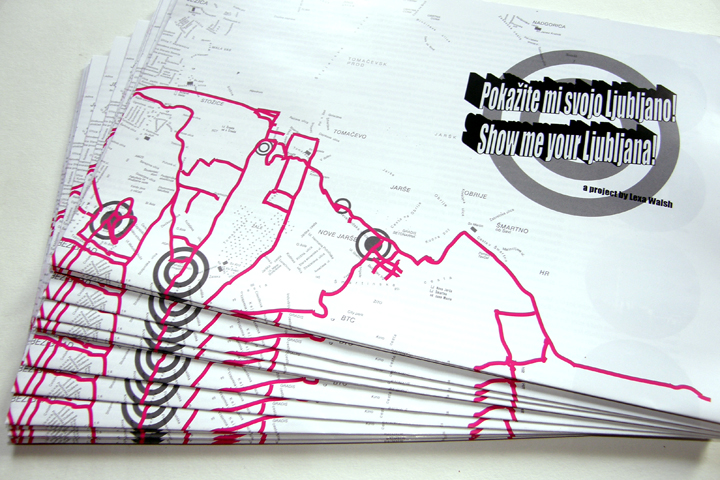
Show Me Your Ljubljana
Socially engaged Public Project, Printed Matter, and Website, Ljubljana, SLO 2009
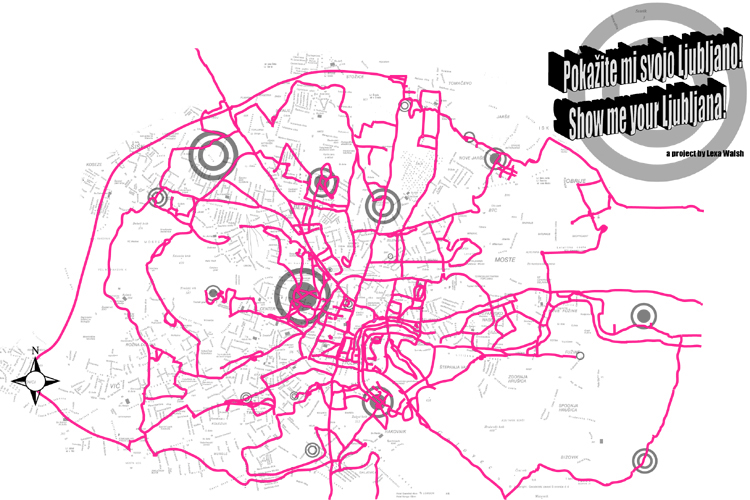
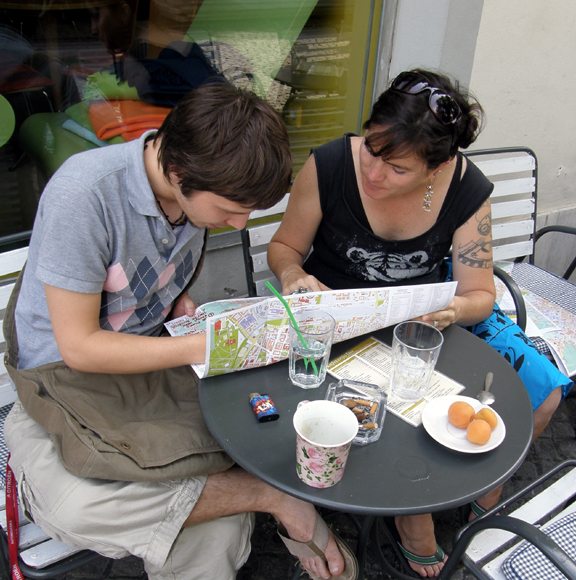
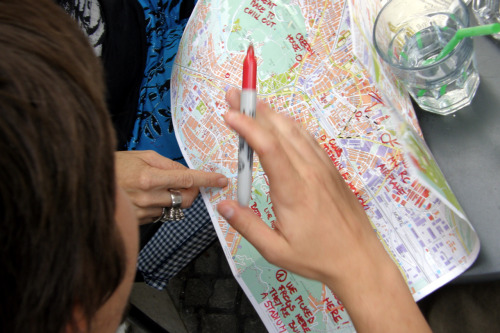
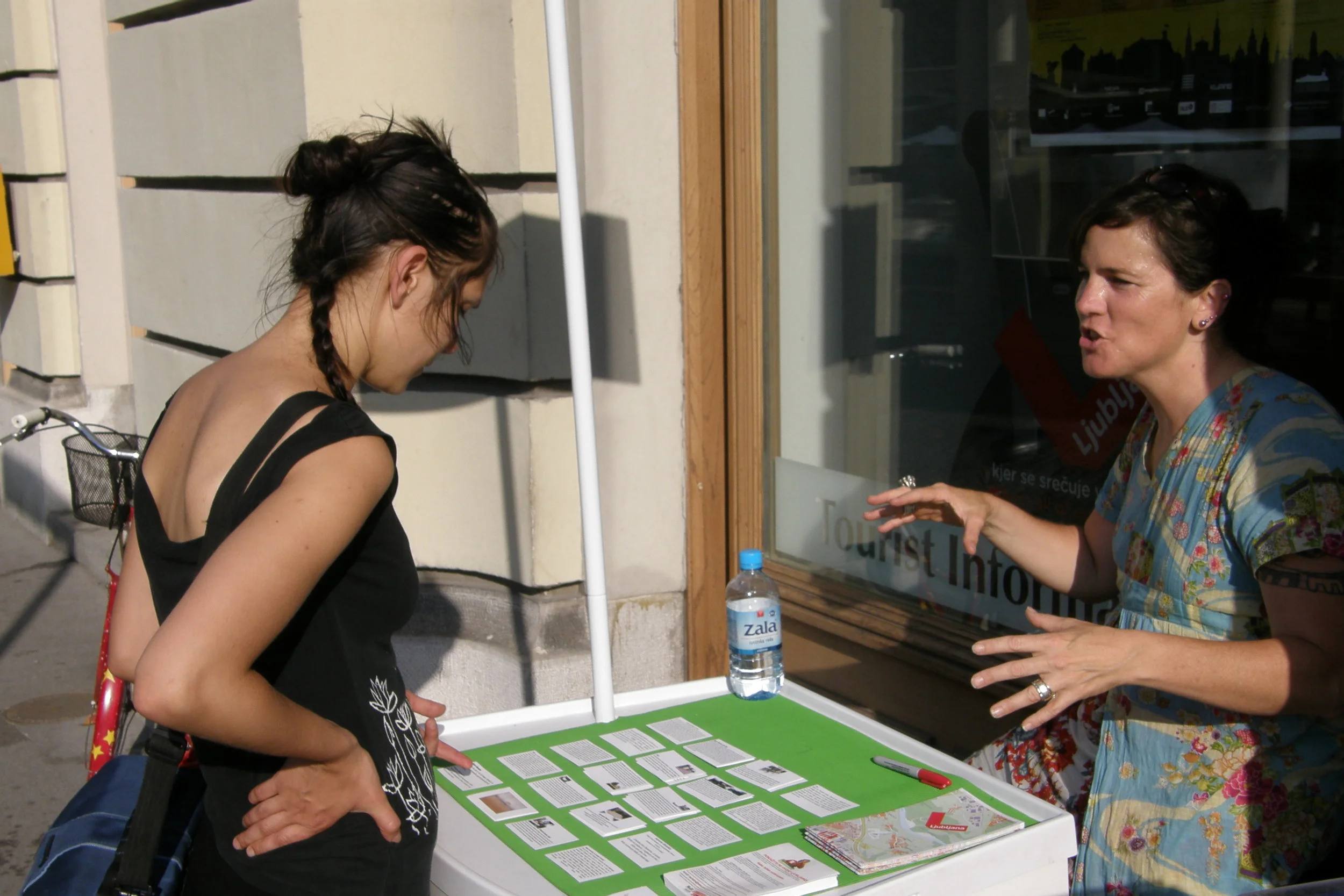
For a 6-week residency at the Museum of Transitory Art (MoTA), I interacted with the public to collect maps of places “I wouldn’t find on my own” and toured the city, resulting in an alternative Tourism Bureau, a series of collectively written songs, a publication “Selected Journeys and Experiences", and a Website
ARTIST AS CARTOGRAPHER OF MEMORY AND SPACE --Neža Mrevlje
Artist Lexa Walsh uses practices that span multiple disciplines in her work. She complements her projects with travel, public works, and experimental music. Her creative focus stems from an interest in history, perspectives, experiences, and stories of ordinary people, objects, and places. She addresses memory, nostalgia, and ingenuity, archetypal thought, and emotional patterns. The intertwining of diverse practices is described by the artist’s shifting identities, through which she enters the role of “archaeologist, cartographer, collector, cultural ambassador, recorder of experiences, researcher, historian.” She is “an initiator, voyeur, and passionate community builder.” The author defines the methodology of her artwork through the tools of (pseudo)anthropology, which is reflected in her studio work as well as in post-production and projects placed in public space.
On her journey through experiences, memories, places, lives and experiences, Lexa Walsh, as an artist in residence at the first Slovenian visual arts residency space, the Mota Museum of Temporary Arts, also stopped in Ljubljana. She invited everyone, passers-by, everyone living in Ljubljana, to the project Show Me Your Ljubljana (the project is taking place in three parts: Traveling around Ljubljana, Ljubljana Jingle Orchestra and First Impressions). She invited them to share their memories, emotions, experiences and perceptions of Ljubljana's urban space with her. Throughout the month-long project, Lexa Walsh indulged in the aftermath of many visions and experiences of Ljubljana, and with their visions and perceptions of the city, the participants and collaborators contributed to building a different image of the city. In an alternative guide to Ljubljana and the tourist office, at the end of the project, the artist reinterpreted and documented a map of Ljubljana, which was created based on the spaces to which individuals referred her, and these were connected to love, work, life, memories, daydreaming, and the like.
Lexa Walsh is currently working primarily on interactive public space projects and performances that actively bring together diverse members of the community. Through social and artistic interventions, observations and interpretations, she creates site-specific works that reinterpret diverse perceptions of space, people and the unfolding of their stories within them through various media. The creation of the tourist office is an international project, and its “results” will also allow for the comparison of different perspectives in the future.
CONTEMPORARY ART AND ITS ETHNOGRAPHIC TURN
American art critic and professor of modern art at Princeton University Hal Foster (2003) puts forward a thesis about the ethnographic turn in contemporary art in his article 'The Artist as Ethnographer'. In doing so, the author refers to Walter Benjamin's text entitled 'The Artist as Provoker' from 1934, in which Benjamin defines the artist as a social benefactor. As someone who, as a worker, should intervene in the means of artistic production and change the "technique" of traditional media and transform the "apparatus" of bourgeois culture (after Foster 2003: 27).
Foster, in further developing his thesis, brings the impossible position of the artist, full of contradictions, torn between history and innovation, between institution and subjectivity, stability and unpredictability, to a confrontation between art and anthropology as a methodology of artistic practices and psychoanalysis as the basis of artistic theory and criticism (2003: 28).
If the artist once ambiguously meant or still (conditionally) means the cultural other, then without a doubt anthropology means a discipline that confronts socioculturally defined otherness. The history of anthropology is the history of speaking about the other. It brings distant worlds closer, and distances the close ones (Eriksen 1995).
The source of anthropological knowledge and mediation, which we analyze through theoretical tools, is based on field experience. James Clifford (1986) in the introduction to the collection Writing Cultures, which he edited with George E. Marcus, speaks precisely about the meaning of fieldwork, its understanding, the position of the ethnographer and ethnographic writing. Coexistence in a certain space and time, where we follow the experience of individuals in this context, as well as our own ethnographic experience, should not posit ultimate truths, but rather, through description, analysis and interpretation – rhetorical tools – speak about particular socio-cultural experience and reality (Clifford 1986: 2).
In the mediation of field experience and in the fieldwork itself, Clifford raises the issue of understanding the ethnographer's authority. Clifford's criticisms regarding the issue of the ethnographer's authority are polemical from the perspective of the anthropologist's position when entering environments, communities and cultures. The ethnographer can thus be understood as a power-holder who ambitiously seeks sophisticated informants, gives nothing in return, and shapes the realities he speaks about. Based on a self-evident authority, he speaks "on behalf of someone else", translates and mediates someone else's reality (Clifford 1986: 7, 9-11).
In this regard, anthropology, which throughout its history speaks about the “other”, has encountered criticism. Anthropology is the one that can represent the “other”, interpret its reality – which can indeed bring emancipatory effects, such as those in the 1950s and 1960s, when it began to devote more intensive attention to issues of colonialism, postcolonialism and the issue of minorities – but taking on the position of a speaking subject “on someone’s behalf” can actually mean confirming power relations. Anthropology thus speaks on behalf of someone who is assumed not only to be invisible and unheard, but even incapable of speaking for themselves. This is why there has been an important turn in anthropology towards fieldwork “at home”, with research into one’s own culture, which offers new insights and a depth of understanding of what is being researched, as Clifford claims. This raises questions about the limits of studying the “self” as well as about revealing the “self” when studying the “other”. An even more important shift occurs with the reflection on the ethnographer as the center of the ethnographic text, the ethnographer as the reference and speaking subject. The reflection on ethnographic discourse has sought meanings in the polyphony of the ethnographic record (Clifford 1986: 7, 9-10, 15).
Polyphony can thus be understood not as a collection of monologues and dialogues, among which there is still a voice of authority, and other voices are sources and informants, but in such a way that informants become co-authors of the ethnographic record, observation and inventory. Clifford (1986: 17) also asks what happens in the case of ethnographic records when interlocutors become co-authors. Ethnography thus becomes even more clearly a collection of textual activities, a consonance of voices that form a discourse about individual realities. Discourse understood in the mirroring and revealing of one’s own reality, which is not controlled, selected and organised through relations of power and authority (Foucault 1991: 4, 22).
Yet in polyphony, the "carnival arena of diversity" (Rainbow after Bakhtin 1986: 246), where there are more authors and voices, the ethnographer still remains a constituting subject and authority, polyphony is problematized by Rainbow (1986) in the article in the aforementioned collection 'Representations are Social Facts: Modernity and Post-Modernity in Anthropology'. As Clifford adds, the polyphony of citation also places the one who quotes. Thus, the ethnographer still balances between the discourses and voices of the ethnographic text (after Rainbow 1986: 246).
The possibilities and morality of anthropological practice, as well as the position of the anthropologist's authority within ethnographic experience and writing, are also addressed by Carrithers (2005) in his article 'Anthropology as Moral Science of Possibilities'. The author starts from the question: can anthropology offer a basis for moral and social criticism and how can we trust the knowledge of anthropology?
The anthropologist's fieldwork encompasses the whole. As the anthropologist shapes the fieldwork and ethnographic writing, the field experience shapes him. He is constructed by the subjects of the fieldwork. Along with the ethnographic experience and the interpretation or embodiment of the practices of fieldwork, it is also necessary to sketch the moral position of the anthropologist. Moral positions as recognition of the value and validity of the world of others, intertwined with professional and personal ethics that emerge in the fieldwork situation (Carrithers 2005: 437, 445).
Carrithers poses the question of morality in anthropology through cultural relativism, which assumes that every moral code is accompanied by different possibilities (this is not a moral relativism). The second level of morality in anthropology is articulated in fieldwork, which includes interactive moral aesthetics. The third level is represented by the rhetorical tool of persuasion (Carrithers 2005: 433). Geertz says that the anthropologist should show the diversity of moral imagination, without being judgmental (after Carrithers 2005: 434).
In interactive moral aesthetics, which is not only anthropological but human in general, Carrithers says that it is about moral creativity-with-passion. Culture is both persuasive, rhetorical, which acts on people and at the same time means their tool. They use cultural tools on themselves and others (Carrithers 2005: 434). The latter can also be linked to the very position of the production of ethnographic knowledge.
Anthropology is a discipline that talks about getting to know “others”, the diversity of worlds and the different possibilities of these worlds. And when we break through to understand the diversity of other worlds, we come to new insights. Insights about our own world, which we reflect through the possibilities and diversity of the other world, and above all, the insight that “there is not just one possible path”, as Marshall Sahlins (1976) claims (after Carrithers 2005: 435). In the midst of clouds of possibilities and diversity, Carrithers refers to the concept of zerrisen, Hegel’s Zerrisenheit, which refers to a torn and fractured world. But the author relies on Adorno’s concept of “negative dialectics”, which shows how the human world, especially the post-Enlightenment world of late capitalism, is torn and fragmented (after Carrhiters 2005: 435). However, Carrithers understands Zerrisenheit as a natural state of the conditions of human life and culture and not as a pathological state of capitalism. The world is thus not torn and fragmented, but a world of clouds of possibilities and alternatives, among which moral aesthetics is situated. It is a world or culture that depicts many moral worlds, with many limitations and boundaries that merge and oppose each other, emerge and can be transformed (Carrithers 2005: 435).
The ethnographer also enters into this diversity between worlds and within the world itself, and into the clouds of moral possibilities, through fieldwork. And the recognition and recognition of the subjects of ethnography is the center of anthropological research. The production of anthropological knowledge depends on the formation of relationships between anthropologists and informants, which is why Carrithers proposes “engaged learning” or learning through collaboration instead of the term observation with participation. Thus, the author does not only place the “ethnographer’s authority” in ethnographic experience and writing, which will speak about the researched, but through interaction, the ethnographer and informant both speak, shape, and are also shaped. In learning through collaboration, the ethnographer takes on the role of “learner.” It is about direct participation, learning about the right and wrong of a certain reality. In this learning, informants also become readers, his companions, and contemporaries (Carrithers 2005: 437, 439).
The artist Lexa Walsh also creates in interaction with individuals. Her artistic practice is a direct illustration of what Foster calls the "ethnographic turn" in contemporary art. Through her projects, Lexa Walsh enters the biographies of the participants and the community she addresses. Through her work in public space and the presentations of this in it, she also gives all this back to the community, showing it new paths and directions. It is about action, about creating possibilities for difference and getting to know difference, spaces of in-betweenness - between the particular and the social. It is about emergence and becoming in interaction.
“The ethnographic turn in contemporary art is also fueled, among other things, by developments within the minimalist genealogy of art of the last thirty-five years. These developments form a sequence of investigations, first of all, into the material components of the artistic medium, then into the spatial conditions of its perception, and finally into the material foundations of this perception; these shifts remain recorded in the minimalist arts of the early sixties and in the conceptual art, performances, body art, and site-specific art of the early seventies. The institution could soon no longer be described in purely prosaic terms (studio, gallery, museum, etc.); it also became a discursive network of different practices and institutions and other subjectivities and communities. The viewer could not be described in purely phenomenological terms either; he or she became a social subject, defined by language and marked by diversity (economic, ethnic, sexual, etc.).” (Foster 2003: 34)
In this way, contemporary art has invaded the expanded field of culture that was supposed to be controlled by anthropology, says Foster (2003: 34). The author cites several examples of practices from the history of art of the 20th century that used sociological or ethnographic mapping of social realities, while not avoiding problematizing this kind of behavior of certain artists, who were attributed arrogance. In social mapping, therefore, reflexivity of action is necessary, since it should contribute to the undermining of power rather than its confirmation.
Spatially specific work that is created in interaction with a community is actually a politics of identities, a displacement of these. In this, the artist can be particularly defined by his reduction of identity, in order to empathize with the other. And when the artist places himself in the identity of a particular community, he is also asked to stand up for this identity and to present it institutionally (Foster 2003: 37-8). In this way, the artist, his experience, interpretation and work embody the mediated experience, the clouds of infinite possibilities and differences that he is supposed to represent.
In the creation of this kind of work, the artist can still embody an institution, a position of power and omniscient subject. And can he actually step down from it?
Through her work, Lexa Walsh speaks about the other, others, and maps, brings their stories closer, interprets, and makes them visible. Through her chosen artistic media and skills, the artist leaves the voice to individuals, and in her work, through processuality and from the position of a "student", she creates a multi-voice. Her work represents perceptions of the community, and through placement in public space, she also returns to it. In doing so, she visualizes its differences and many clouds of possibilities.
But anyway, as the versatile stage creator from Dubrovnik, Boris Kadin, claims, who in his play titled What Did Joseph Beuys Tell Me When I Was Lying Dead in His Arms? (Slovenia, Croatia) analyzed the question of interpreting a work of art and reflected on his relationship to art, the analysis of works of art and the theory of contemporary art, every analysis immediately establishes a context for a work of art. Whether it is appropriate or completely wrong does not depend on the artist, his interpretations and desires, but is established independently of him.